As an Amazon Associate we earn from qualifying purchases. Every buy button leads to Amazon.As an Amazon Associate we earn from qualifying purchases.Full disclosure →Disclosure →
GUIDE / INTERIOR CARE

She rides open.
Keep her clean.

Pull the doors and every surface in that cabin — dash, seats, door sills, hinge pockets — is a direct target for UV, grit, rain, and whatever the trail throws up. Here's the routine that keeps it all from turning into a crime scene by August.

The doors-off interior question isn't hard, but it's easy to skip — and by the time you notice your dash is chalking and your seat bolsters are packed with grit, you're reversing damage instead of preventing it. This guide covers what to use, in what order, and what gear keeps the cabin organized when there's no door left to hold things in.

Why the open cabin punishes your interior

A factory Jeep interior was designed for doors. Remove them and you've taken away the first line of defense against everything the environment throws at you: UV radiation hammers the dash and seat fabric, trail grit packs into every seam and seat bolster, rain blows in sideways on any run with weather, and the exposed door-hinge pockets become little rust nurseries every time they hold damp grit for a few days.

None of this is catastrophic if you stay ahead of it. It becomes expensive — cracking vinyl, bleached fabric, seized hinge pins — if you ignore it for a full season. The fix is a consistent post-run routine and a few targeted products, not a full detailing session every weekend.

The right cleaning sequence

Order matters here. Wet-cleaning over dry grit turns abrasive particles into a scrub pad against your surfaces — so always get the loose material out first.

  1. Dry-brush or vacuum first. A soft detailing brush or handheld vacuum pulls grit out of seat seams, carpet pile, and vent slots before you introduce any moisture. Don't skip this step — it's what prevents micro-scratches on vinyl and painted dash plastic.
  2. Clean vinyl and hard plastic. Use an interior cleaner formulated for automotive vinyl — something pH-neutral that lifts grime without stripping whatever UV protection your factory finish has left. Wipe with a microfiber cloth, not a paper towel.
  3. Clean fabric seats and carpet. A foam-style fabric cleaner works on seat cloth and floor mats without soaking through to the foam underneath. Work it in with a soft brush, then wipe the residue off clean.
  4. Apply UV protectant to dash and vinyl surfaces. Dry-touch or matte-finish formulas are the right call — the old-school silicone-heavy dressings attract more dust than they repel and turn greasy in direct sun. A UV-blocking protectant buys you another season of un-cracked, un-chalked surfaces.
  5. Hit the hinge pockets and striker plates separately — see below. They need a different approach than the interior surfaces.

Vinyl, plastic, and the dash — what to use and what to avoid

The JL/JT dash is a textured hard plastic, not soft vinyl — but it still chalks and fades under sustained UV with no tinted door glass and no door panel providing any block. The seat surfaces on base models are a vinyl/cloth mix; Rubicon and higher trims run a softer leatherette that's more susceptible to cracking when it dries out.

  • Use a dry-touch UV protectant. Avoid anything labeled "high gloss" or "wet shine" on dash surfaces — it makes the gauge cluster reflect into your eyes and turns greasy in the heat.
  • Don't use all-purpose cleaner at full strength on soft vinyl. Dilute it, or use a dedicated interior cleaner. Full-strength APC strips surface treatment faster than the UV does.
  • Reapply every 4–6 weeks through peak season. A product sprayed on in April isn't still working in August. The cadence that actually holds is more frequent than most people expect.
  • Seat-back vinyl is a different surface than dash plastic. Some protectants that are fine on one will haze the other. Test in an inconspicuous spot if you're switching products.

Fabric seats, carpet, and the rain question

If you're running factory cloth seats and you go doors-off in variable weather, you will eventually get wet seats. A foam fabric cleaner applied periodically and a water-repellent treatment on the cloth extends the life of factory upholstery and makes recovery from a surprise shower significantly less grim.

For Jeeps that see regular trail use, a seat cover designed to stay put on textured Jeep seat bolsters is worth considering. Most generic slip-on covers migrate on the first hard turn and end up crumpled on the floor. Look for covers with elastic or strap systems that anchor at the headrest and under the seat base, and that use outdoor-rated material — polyester or neoprene-adjacent fabrics handle sun and rain better than cotton-poly blends.

Carpet is almost always nylon on JL/JT — it doesn't fade the same way vinyl does, but it holds mud and grit deep in the pile where a vacuum alone won't reach. A foam carpet cleaner agitated with a stiff bristle brush gets significantly further than a wet rag wiped across the top.

SECURE THE CABIN

Storage that keeps gear in bounds

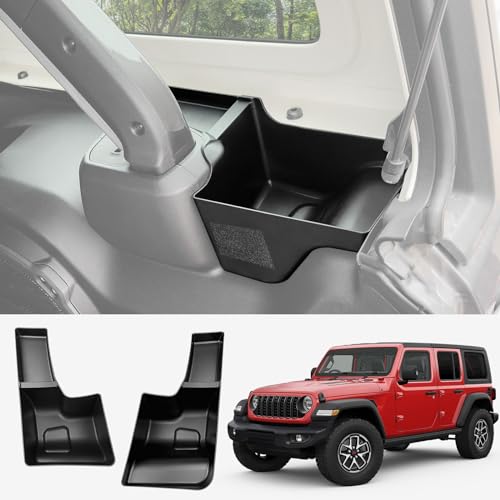
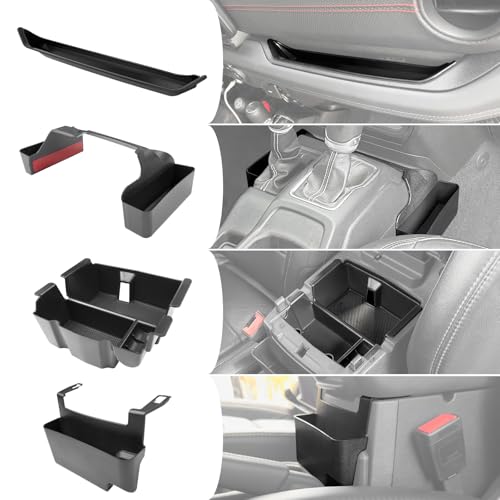
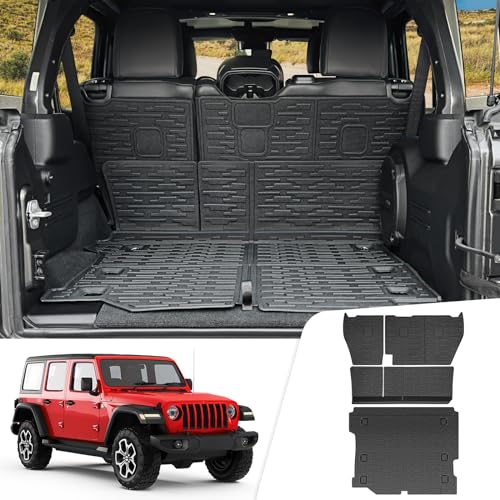
With the doors gone the cabin is an open bed. These three products keep loose gear from migrating to the floor — or out of the Jeep entirely on a hard turn.

See all storage & organization →

Door hinges and striker plates — the part most people forget

The exposed door-hinge pockets are small, shaped to capture water, and coated with enough factory paint that owners assume they're fine. They're not. Every off-road run packs trail grit into those pockets; add moisture and you've built a rust reactor that works slowly and invisibly — until you try to reinstall your doors and find surface corrosion on the hinge pins and striker plates.

  • After every doors-off run, flush the hinge pockets with clean water and dry them with a rag or compressed air. Ten seconds per side. Genuinely worth doing.
  • Hit the striker plate faces and hinge pins with a dry lubricant — not WD-40, which is a moisture displacer, not a long-term lubricant, and attracts dust as it dries. A dry-film PTFE or silicone lubricant stays slick and doesn't collect grit.
  • Check for surface rust at the start and end of doors-off season. Light rust on hinge faces responds to a light wire brush plus rust converter; pitted pins are a harder fix.
  • The JL introduced a torque spec on the hinge bolts — 51 ft-lbs per the factory service manual. If you've been torquing by feel, check with a torque wrench. Under-torqued hinges let the doors flex on reinstall, which accelerates wear on the striker latch over time.

Loose gear and the projectile problem

Doors do more than keep weather out — they're a wall that stops things from exiting the cabin sideways. Take them off and a water bottle, a jacket, or a tool bag left on the seat becomes a hazard on a hard turn or a steep traverse.

The answer is tiered: put cargo where it can't move, and give everything a home that doesn't rely on the door being there. A cargo liner in the rear keeps the trunk load contained and adds seat-back protection that matters when you're loading gear against the second row. Wheel-well bins use dead space that otherwise holds loose straps and gets walked on. The center console organizer keeps the stuff you reach for constantly — sunscreen, sunglasses, multi-tool — out of the cupholder pile and actually reachable.

For larger trail gear, a cargo net or a dedicated bag with a fixed mounting point works better than loose placement. The goal isn't minimalism — bring what you need — it's making sure what you bring can't become a hazard when the angles get steep.

STRAIGHT ANSWERS

Interior care FAQ.

How often should I clean my Jeep interior when running doors-off?
After every significant trail run and after any rain event. A quick dry-brush and vacuum takes five minutes and prevents the grit-to-scratch cycle. A fuller clean — fabric cleaner on seats, vinyl wipe, UV protectant — every 3–4 weeks through peak doors-off season is a reasonable cadence.
What's the best UV protectant for a Jeep dash?
A dry-touch or matte-finish automotive UV protectant beats the old-school silicone 'shine' products. The shiny formulas attract dust, turn greasy in heat, and reflect glare off the dash into your eyes. Look for UV-block ratings on the label, not gloss level.
Will seat covers protect from rain when the doors are off?
They help, but fit is what matters. A cover with a poor seat fit migrates on the first trail obstacle and ends up crumpled on the floor. Look for neoprene-adjacent or outdoor-rated fabric, and a design that anchors at the headrest and under the seat base — not just a slip-on bag.
Will my door hinges rust if I run doors-off all summer?
They can, especially in humid climates or on muddy runs. The hinge pockets collect grit and moisture and hold it. A short flush-and-dry routine after each run, plus a dry-film lubricant on the hinge pins and striker plates, keeps surface rust at bay through a full season.
What lubricant should I use on Jeep door hinges?
A dry-film PTFE or dry silicone lubricant is the right call — it stays slick, doesn't attract trail dust, and won't wash off in one rain the way WD-40 does. WD-40 is a moisture displacer, not a lasting lubricant — it evaporates and leaves a sticky residue that captures more grit than it repels.
How do I keep loose gear from flying out when the doors are off?
Give it a home it can't leave on its own. A cargo liner in the rear, wheel-well storage bins, and a center console organizer account for most of the loose-gear problem. For anything larger — recovery straps, a bag — use a cargo net or a bag with a fixed mounting point so it can't migrate when the angles change.
Is it OK to use all-purpose cleaner on Jeep interior vinyl?
Diluted, yes — most APC products work fine at 10:1 or more. Full-strength APC is too aggressive for interior vinyl over time; it strips surface treatments and can dry out or fade the material. Use an interior-specific vinyl cleaner, or dilute your APC significantly before applying.
JK vs. JL — are the interior care needs different?
The surface types are largely the same (textured hard plastic dash, fabric or vinyl/leatherette seats), but the JL/JT introduced a more refined interior with softer touch-point plastics. The same products work across both generations. The JL rewards regular maintenance a bit more visibly because the materials hold their look better when kept up.

General guidance for Jeep Wrangler and Gladiator owners, not professional detailing advice. Product types and cleaning methods vary — always test any cleaner or protectant on an inconspicuous area first. Structural rust or hinge damage should be assessed by a qualified shop.

STAY DIALED

Open cabin.
Clean rig.

Sort the routine once, stock the right gear, and your interior weathers the season instead of wearing it. And before you pull the doors — check the forecast. It scores the week so you know exactly which days are go days.